
Agentic AI Playbook: How Founders Deploy Autonomous Agents to Unlock Product-Led Growth
- Agentic AI
- Autonomous Agents
- Product-Led Growth (PLG)
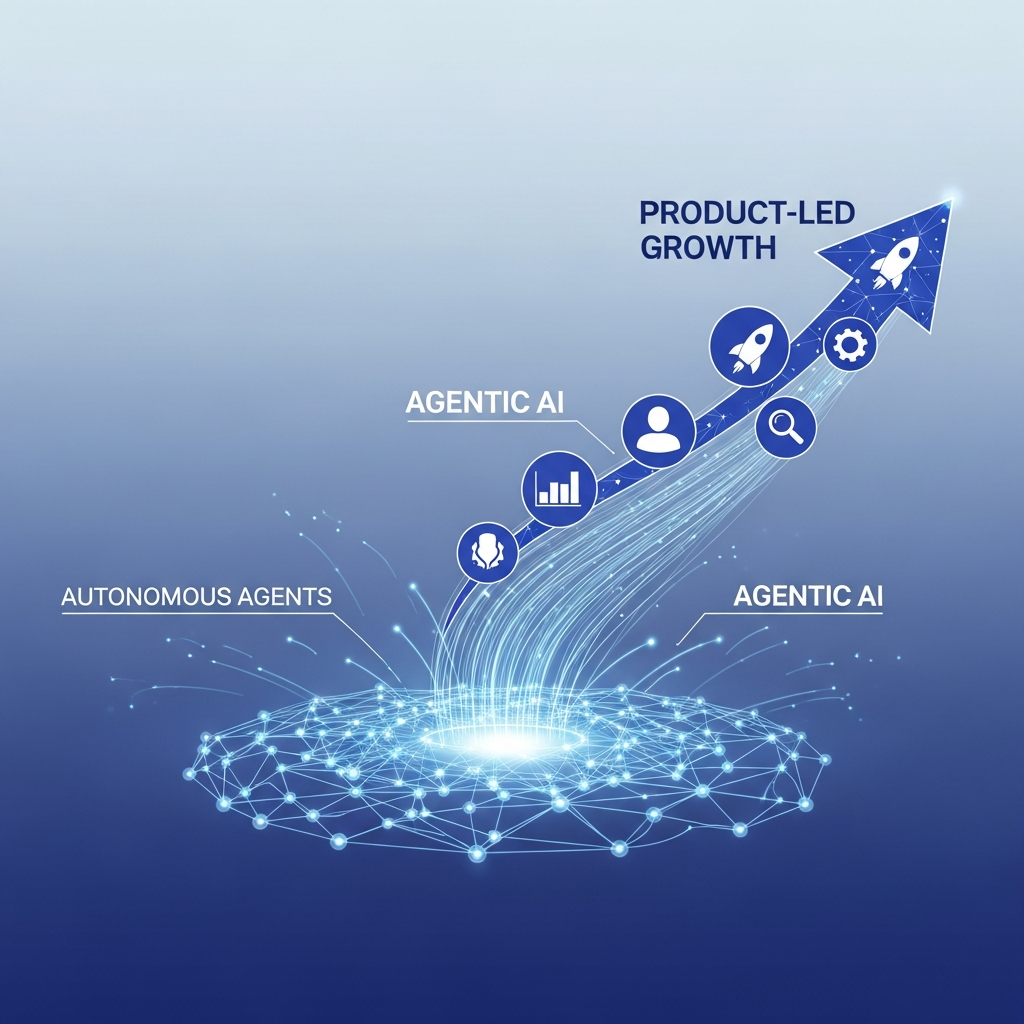
Agentic AI Playbook: How Founders Deploy Autonomous Agents to Unlock Product-Led Growth
- Founder's problem: scaling growth without scaling headcount
- Outcomes at the center: agentic ai for business in PLG
- How autonomous agents operate inside SaaS products
- Real-world inspired deployment patterns
- Traditional automation vs. agentic AI for PLG
- Workflows, decision loops, and feedback systems
- Risks, limitations, and governance
- Founder Checklist / Deployment Framework
- From MVP to scale: deployment roadmap
- Next steps for founders
Founder's problem: scaling growth without scaling headcount
SaaS leaders consistently face a stubborn tension: how to accelerate growth while keeping headcount in check. Customer acquisition costs stay high, expansion revenue stalls, and relying on more people to drive every activation feels unsustainable. The dilemma isn’t just about efficiency; it’s about resilience. If a product can guide users toward value with fewer humans in the loop, growth scales. That is the core motivation behind Agentic AI for business in a product-led framework. This playbook centers on outcomes, on what an autonomous agent can consistently deliver inside a product: shorten time-to-value, improve activation rates, reduce support friction, and nudge users toward expansion. It’s about embedding decision-making that mirrors thoughtful human guidance, but at scale and with feedback loops that continuously improve.
Outcomes at the center: Agentic AI for business in PLG
Agentic AI reframes automation as living, adaptive guidance inside the product. The aim isn’t to replace humans but to enable more deliberate, data-informed interactions at moments that matter in the user journey. The primary outcomes founders should expect include:
- Faster onboarding completion and faster realization of value.
- Higher activation rates through proactive guidance tailored to user context.
- Lower churn by identifying at-risk moments and delivering timely interventions.
- Increased expansion velocity via intelligent nudges for upsell, cross-sell, or premium features.
- Smarter experimentation with low-friction, continuous learning loops.
Think of Agentic AI not as a feature but as a programmable advisor embedded in the product. The advisor uses usage signals, context, and business rules to decide what to do next, then learns from outcomes to do it better next time. That is value in action for product-led growth.
How autonomous agents operate inside SaaS products
Autonomous agents in a PLG SaaS product operate across the user lifecycle: onboarding, activation, retention, and expansion. Each stage has decision points where a lightweight agent can make a meaningful impact without requiring a full rewrite of the product.
Onboarding: reduce friction by personalizing the first-value path
When a new user signs up, the agent analyzes behavior signals, role, and stated goals to tailor the onboarding journey. It surfaces context‑ aware checklists, suggests relevant tutorials, and nudges users toward the first high-value action. The result is a smoother start and a clearer path to value.
Activation: accelerate time-to-value with guided tasks
Activation is about completing a critical milestone that demonstrates product value. An autonomous agent can offer guided tasks, auto-fill configuration steps, and request essential data points in a minimally disruptive way. By lowering cognitive load, users reach the activation milestone faster and with higher confidence.
Retention: sustain engagement with continuous value signals
Retention agents monitor usage cadence, feature adoption, and outcomes. They trigger lightweight experiments, like feature prompts, in-app tutorials, or micro-wizards - when usage dips. The agent’s goal is to remind users of value, surface relevant to-dos, and preempt disengagement.
Expansion: unlock expansion through guided, context-aware recommendations
As usage grows, the agent identifies upgrade opportunities aligned with user outcomes. It recommends features that expand the customer’s value, presents a frictionless upgrade path, and clarifies ROI implications. The agent treats expansion as a natural extension of ongoing value, not a sales interruption.
Real-world inspired deployment patterns
In practice, successful PLG teams deploy autonomous agents as lightweight agents embedded in the user interface, backed by usage telemetry and business rules. Consider these patterns that have emerged across mature SaaS workflows:
- Onboarding coaches: An agent watches a user begin the product and selectively presents the most relevant setup steps, linking to context‑specific docs or short videos.
- Activation nudges: When a user attempts a meaningful action (e.g., creating a project, connecting a data source), the agent provides a guided walkthrough and auto-fills common configurations.
- Retention allies: If usage drops after a heat point, the agent surfaces a tailored tip, offers a one-click tutorial, or schedules a micro-demo with a human if needed.
- Expansion copilots: The agent analyzes feature usage and suggests an upgrade aligned with the user’s outcomes, presenting ROI-focused benefits and a frictionless upgrade path.
These patterns replace generic, one-size-fits-all messages with adaptive interactions that reflect user context. They also reduce support load by answering common questions within the product experience, not in a separate channel.
Traditional automation vs. Agentic AI for PLG use cases
Traditional automation excels at rule-based, repetitive tasks but struggles with context sensitivity. Agentic AI treats workflow as a living system, able to respond to signals, learn from outcomes, and adjust its actions. Here’s how the two compare in core PLG scenarios:
- Rules-driven guides vs. context-aware, adaptive guidance that adjusts to user role and progress.
- Static checklists vs. proactive, task-driven assistants that complete steps and capture needed data automatically.
- Retention: Static emails vs. in-product nudges that respond to engagement signals in real time.
- Expansion: Triggered campaigns vs. intelligent recommendations grounded in observed outcomes and ROI signals.
In short, Agentic automation aligns product operations with real user behavior, turning growth experiments into continuous product optimization rather than episodic campaigns.
Workflows, decision loops, and feedback systems
A practical Agentic AI system for PLG relies on three interconnected layers: workflows, decision loops, and feedback systems.
Workflows
Define lightweight, event-driven workflows tied to the product’s value milestones. Each workflow has a trigger (e.g., user signs up, completes a task), a set of agent actions (guided steps, prompts, data collection), and a desired outcome (e.g., activation, first value, upgrade interest).
Decision loops
Decision loops are the heart of autonomy. The agent observes signals, applies business rules, and selects an action. It uses simple policy trees for MVP and grows to probabilistic scoring as data accumulates. Each decision is explainable in terms of the signal that triggered it and the expected outcome.
Feedback systems
Measure outcomes, not outputs. Track activation rates, time-to-value, churn signals, and expansion velocity. Use dashboards to compare cohorts, and run rapid tests to refine prompts and flows. The feedback loop should inform policy updates weekly or biweekly, never as a one-off change.
Risks, limitations, and governance
Agentic AI is powerful, but it requires governance. Key risks include over‑automation, privacy concerns, bias in guidance, and dependency on external data and models. Mitigate these with guardrails, clear ownership, and auditable decision logs.
- Define data sources, retention, and access controls. Ensure compliance with relevant regulations and security standards.
- Provide users with visibility into automated guidance and easy opt-out options.
- All agents should have a safe fallback if signals are missing or if actions fail.
- Start with a minimal MVP, validate ROI, and expand in controlled increments.
Governance isn’t a blocker; it is the architecture that makes continuous improvement possible. Build it in from day one with clear accountability, guardrails, and measurable outcomes.
Founder Checklist / Deployment Framework
Use this concise framework to move from concept to an MVP that actually proves value.
- Specify the value you want from onboarding, activation, retention, and expansion. Pick 2–3 core metrics to optimize first.
- Chart the user journey and identify moments where guidance most impacts outcomes.
- Start with a single MVP-enabled agent in a high-impact area (e.g., onboarding coach or activation navigator).
- Ensure you can surface the right signals (events, properties, and user context) for the agent to act on.
- Establish the initial set of prompts, actions, and guardrails. Keep the scope small and testable.
- Put decision-logs, audit trails, and opt-out controls in place before launch.
- Set up dashboards to track ROI and establish a weekly review cadence for policy updates.
- Run a 6–8 week MVP with clear go/no-go criteria and a minimal operating model.
From MVP to scale: Deployment roadmap
Adopt a pragmatic, staged approach. Each stage should deliver measurable value and learning that informs the next one.
Stage 1 - MVP
Launch a single agent in a narrow use case with a small user segment. Use simple rules and a handful of signal types. Collect qualitative feedback and track one primary outcome metric.
Stage 2 - Validation
Expand to a second workflow and increase signal richness. Validate ROI with early results and refine prompts, flows, and safety rails.
Stage 3 - Scale
Roll out to broader user cohorts, introduce additional agents for onboarding, activation, and expansion, and connect to expansion metrics (up-sell, cross-sell, premium features). Maintain governance and continuous learning cycles.
Next steps for founders
Start with a concrete, value-driven MVP that you can defend with observable outcomes. Build your Agentic AI capability as a programmable extension of your product team, not as a separate project. When done well, it becomes a growth engine that scales with your product, not with headcount. Begin by aligning on 2–3 outcomes, ensuring data readiness, and drafting a simple decision framework. Treat the MVP as a product experiment: set scope, define success, and learn fast. The goal is not a flashy demo; it is measurable, repeatable growth powered by autonomous guidance inside your product.