
AI-Driven Cloud Migration Blueprint
From legacy to intelligent cloud
- Cloud Modernization
- Multi-Cloud Strategy
- DevOps Intelligence
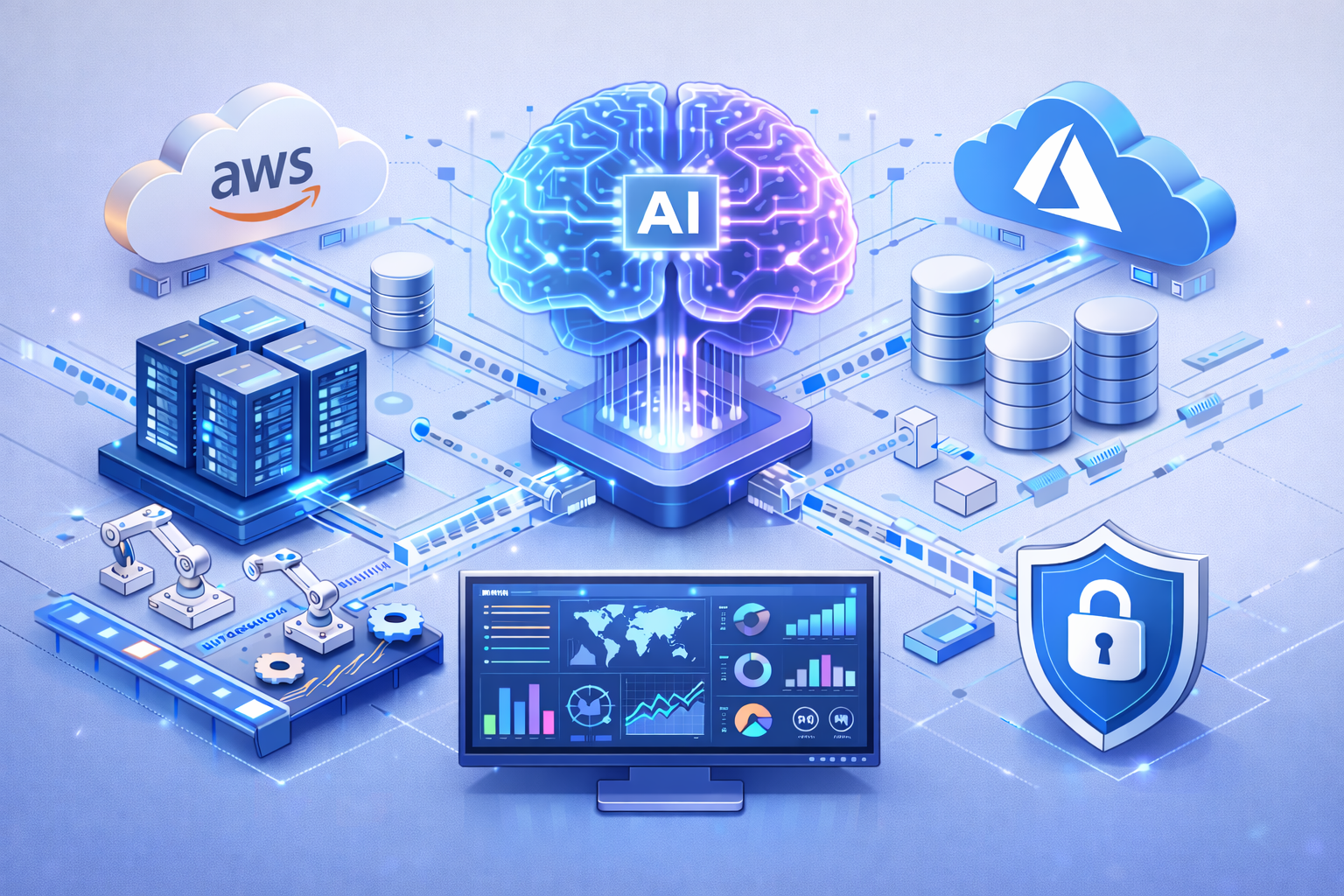
AI-Driven Cloud Migration Blueprint
Why AI-Driven Cloud Migration
Cloud migration is not just a technical lift; it is an organizational transformation. When you layer AI-driven insights on top of migration patterns, you move from a static, planned exercise to a dynamic, data-informed program. AI can reveal hidden inefficiencies in your application portfolio, optimize resource allocation, and guide decision-making about what to rehost, replatform, or refactor. For CTOs and platform leaders evaluating modern cloud strategies, an AI-driven approach aligns technical feasibility with business value—reducing downtime, accelerating delivery, and lowering total cost of ownership.
In practice, AI helps answer critical questions early in the program: Which workloads are suitable for a lift-and-shift, and which should be re-architected for cloud-native patterns? Where do you stand on cost optimization as you migrate? Which parts of the data estate require re-segmentation or schema evolution? By incorporating AI at the discovery, planning, and migration execution stages, teams can de-risk complex moves while maintaining a strong security posture.
The result is a roadmap that marries proven cloud patterns with intelligent automation—an approach that is especially valuable when operating environments span AWS and Azure. The goal is not only to move to the cloud but to establish a foundation that continuously learns from usage data, optimizes costs, and improves performance over time.
Migration Architecture Options
A successful migration does not rely on a single pattern. Instead, it embraces a spectrum of approaches tailored to each workload’s needs. Core options include lift-and-shift (rehost), replatforming (modernizing with cloud-native services), and refactoring (rewriting for cloud-native architectures). An AI-assisted framework helps determine the right mix for your portfolio.
Lift-and-shift (rehost) is often the fastest path to the cloud, preserving existing architectures while enabling better security controls and scalability. Rehosting accelerates migration for greenfield projects and legacy systems that would require extensive redesign. Replatforming, by contrast, enables a more optimal cloud experience by replacing portions of the stack with managed services (for example, moving from on-premises databases to managed cloud databases or container orchestration). Refactoring or re-architecting involves deeper modernization to leverage cloud-native patterns, microservices, and event-driven designs.
The AI layer augments decision-making at each stage: it analyzes dependency graphs, maps data lineage, assesses performance profiles, and predicts the likely cost and downtime for each pattern. When combined with a well-defined migration window and rollback plans, AI-supported choices reduce speculative risk and shorten the path to production.
AI-Enabled Migration Patterns
Implementing AI-driven migration starts with strong data and observability. The following patterns illustrate how AI can guide practical decisions:
- Discovery and Dependency Mapping with AI: Use AI to automatically discover services, identify interdependencies, and classify workloads by criticality. This reduces manual mapping time and improves accuracy in planning cutover sequences.
- Data Migration Intelligence: AI can prioritize data sets based on access frequency, sensitivity, and regulatory requirements, guiding schema evolution and data staging strategies.
- Pattern-Based Target Architecture: AI suggests whether a workload should be rehosted, replatformed, or refactored based on performance profiles, latency sensitivity, and integration complexity.
- Adaptive Cutover Planning: Predictive models simulate downtime scenarios and optimize the sequence of migration events to minimize impact on users.
- Perf and Cost Optimization: After migration, continuous AI-driven optimization recommends instance types, autoscaling configurations, and reserved capacity to reduce bills.
Practical tips: start with a pilot of 2–3 representative workloads, measure outcomes, and then scale the AI-driven approach across the remainder of the portfolio. Build a feedback loop so AI models improve as you migrate more workloads.
Cloud Cost Optimization with AI
Cost is a primary concern in cloud migrations. AI-driven cost optimization treats cloud spend as a dynamic system, continuously analyzing utilization patterns and adjusting resources in real time. Techniques include right-sizing, spot and preemptible instance strategies, autoscaling policies tuned by AI, and adaptive workload scheduling to leverage cheaper windows.
FinOps maturity matters. AI augments FinOps by providing prescriptive cost recommendations, forecasting future spend with scenario analyses, and surfacing anomalies before they become budget shocks. In AWS and Azure environments, AI can monitor unused reservations, idle capacity, and underutilized data transfer paths, recommending consolidation or reallocation.
A practical approach combines automated cost baseline creation, ongoing optimization, and periodic governance reviews. Establish a cost metric dashboard that ties directly to business value—e.g., cost per customer, cost per compute unit, or cost per feature—to help executives see ROI in near real time.
Cloud Native DevOps Automation
Cloud-native DevOps is a prerequisite for reliable migration and ongoing modernization. AI accelerates the automation agenda by guiding CI/CD pipelines, infrastructure as code (IaC), and deployment orchestration. Key practices include AI-assisted pipeline optimization, automated testing in production-like sandboxes, and continuous verification of security and compliance checks.
For multi-cloud environments (AWS and Azure), unified deployment pipelines reduce friction and prevent drift between clouds. Utilize IaC tooling (such as Terraform or ARM templates) with policy-as-code to enforce governance across environments. AI can help schedule maintenance windows, predict the impact of changes, and auto-generate rollback plans when anomalies are detected.
Operational excellence hinges on observability. Deploy comprehensive telemetry, including tracing, metrics, logs, and security events. Use AI to correlate signals across services, surface root causes, and automatically adjust autoscaling or failover strategies to protect SLA commitments.
Secure Cloud Migration Strategy
Security cannot be an afterthought in a migration. An AI-assisted approach integrates secure-by-default configurations, continuous risk assessment, and proactive threat modeling. Key controls include identity and access management (IAM), encryption in transit and at rest, key management services, and strong data governance policies.
In practice, cloud providers offer mature security services—such as AWS IAM, KMS, GuardDuty, and Macie, or Azure Active Directory, Key Vault, Defender, and Purview—that can be combined with AI-driven anomaly detection and automated remediation. A secure cloud migration strategy emphasizes least privilege, strict segmentation, and auditable change trails. As workloads move to cloud-native architectures, ensure data residency and privacy requirements are respected, particularly for regulated industries.
Governance, Risk, and Compliance
Strong governance reduces risk when moving to the cloud. AI-enabled governance involves policy-as-code, continuous compliance checks, and automated risk scoring. Establish a cross-functional steering committee, define clear RACI matrices for migration phases, and codify decision rights so that architecture decisions are traceable and auditable.
A practical governance framework includes 1) a well-defined data classification scheme and handling procedures, 2) alignment with industry standards (such as ISO 27001, SOC 2, and relevant regulatory requirements), and 3) regular security exercises (tabletop scenarios, red team exercises) to validate incident response capabilities.
Remember that cloud maturity is not binary. Start with a baseline security posture in the pilot phase and progressively raise your level of automation in governance, risk assessment, and control enforcement as you scale.
Vendor Evaluation and RFP Guide
For CTOs evaluating migration partners and automation platforms, a rigorous vendor evaluation framework is essential. Use a scoring rubric that covers technical fit, security posture, operational governance, and delivery capabilities. Include AI maturity, cloud-native experience, multi-cloud orchestration, and hands-on experience with AWS and Azure patterns.
In your RFP, request: 1) demonstrated cost optimization results from prior migrations, 2) references from similar industries, 3) a concrete migration blueprint with milestones and rollback options, 4) details on data migration strategies and data governance measures, and 5) a plan for ongoing optimization after migration.
Clarify engagement models: dedicated teams, managed services, or project-based pricing. Ask for security certifications, incident response SLAs, and evidence of continuous integration and continuous delivery (CI/CD) maturity. Finally, insist on a transparent governance structure, including weekly status updates, risk dashboards, and audit-ready documentation.
Actionable Migration Roadmap
A practical roadmap combines time-bound phases with AI-augmented decision points. Below is a high-level 90-day plan designed to de-risk the first wave of migration and establish a foundation for ongoing optimization.
- Phase 1 — Discovery and AI-Assisted Inventory (Days 1–14): inventory all workloads, identify dependencies, classify data, and define success metrics. Establish baseline cost and performance targets. Create a pilot slate of 2–3 workloads to test approaches.
- Phase 2 — Target Architecture and Pattern Selection (Days 15–30): use AI recommendations to select migration patterns (rehost, replatform, refactor) for each workload. Define data migration strategy and security controls. Prepare initial IaC templates.
- Phase 3 — Pilot Migration and Validation (Days 31–60): execute the pilot with automated testing, observe performance, and adjust autoscaling, network topology, and security settings. Validate downtime targets and rollback procedures.
- Phase 4 — Scale-Up with AI-Driven Optimization (Days 61–90): extend migration to remaining workloads, implement continuous cost optimization, and stabilize cloud-native operations. Establish ongoing governance and reporting cadence.
This roadmap is a blueprint. Your actual plan should reflect your portfolio, regulatory constraints, and business priorities. Each phase should include clear success criteria, risk registers, and a decision gate to proceed or adjust.
Case studies and ROI
While every organization is unique, several patterns recur in AI-driven cloud migrations. Common benefits include shorter downtime windows, improved resource utilization, and predictable cloud spend. A well-governed program can yield measurable ROI by lowering cost per transaction, reducing time-to-market for new features, and increasing system resilience.
Real-world ROI can be demonstrated through metrics such as reduced monthly cloud spend by optimizing idle resources, faster release cycles enabled by AI-assisted CI/CD, and lower mean time to recovery (MTTR) due to better observability and automated remediation. Build a dashboard that ties migration progress to business outcomes—tickets resolved, features deployed, and cost per feature.
Next Steps
If you are evaluating AI-enabled cloud migration as part of a modernization program, begin with a structured assessment. Identify the workloads with the highest business impact, establish security and governance baselines, and define a pilot strategy that combines AI-assisted decision making with proven cloud patterns.
For teams considering vendor partnerships, request a tailored migration blueprint and a cost-optimized, risk-aware plan. Align your internal stakeholders around a common migration language: AI-informed decisions, cloud-native architectures, and continuous optimization.
Ready to start? Consider scheduling a strategy workshop or a discovery call to explore how an AI-driven migration approach can accelerate your cloud journey while controlling risk and cost. As you plan, ensure that your roadmap reflects both immediate migration needs and long-term platform ambitions.