
Cloud Migration Decision Map for CTOs: Balancing Cost, Compliance and AI Readiness
- all
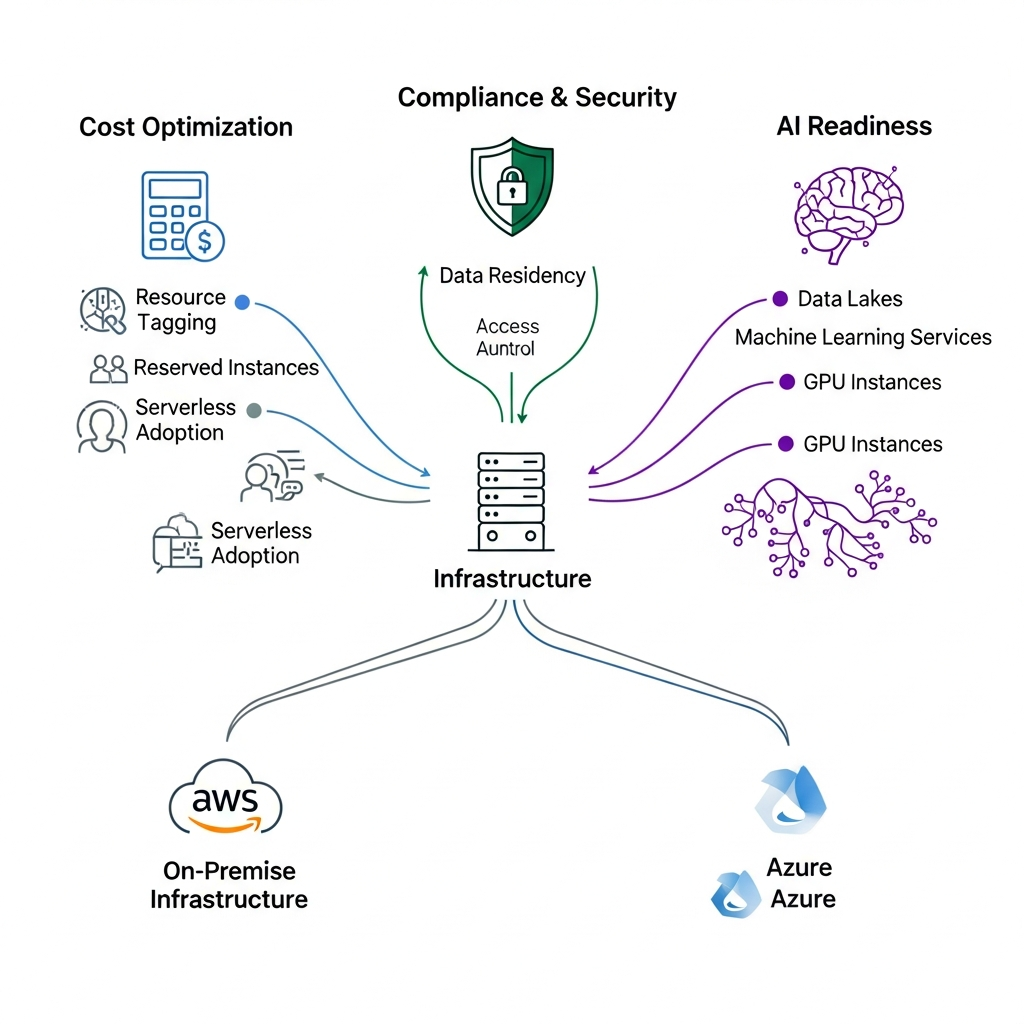
Cloud Migration Decision Map for CTOs: Balancing Cost, Compliance and AI Readiness
Why CTOs need a cloud migration strategy
In enterprise technology programs, migration is not a one-off event but a strategic journey. A formal strategy aligns business outcomes with technical capabilities, reduces risk, and improves predictability in delivery. The right plan helps you balance cost, compliance, and AI readiness from day one.
Without a strategy, organizations drift into ad hoc migrations that create silos, duplicate data, and unplanned outages. A well-defined map clarifies priorities, identifies critical workloads, and establishes governance models that scale as cloud maturity grows.
What a good strategy delivers
- Clear migration goals aligned to business outcomes
- A prioritized backlog of workloads with migration trajectories
- Defined security, privacy, and compliance controls
- A plan for modern architectures and automation
Assessing your current state before migrating
Assessing where you stand today is the first step in any cloud migration. This means cataloging workloads, data flows, dependencies, and security postures. It also means gauging organizational readiness for operational changes, including new DevOps practices and partner governance.
Key activities include inventorying applications, mapping data classifications, and performing risk assessments. The output is a decision-ready matrix that guides which workloads are candidates for rehost, replatform, or refactor.
Inventory and classification
Capture workloads by criticality, data sensitivity, regulatory requirements, and expected modernization effort. This becomes the backbone for your migration plan.
Security and compliance baseline
Document current controls, IAM models, encryption standards, and audit trails. This baseline informs future governance and ensures posture parity post-migration.
Migration path options: rehost, replatform, refactor, rebuild, replace
There are multiple trajectories for moving workloads to the cloud. Each path has trade-offs in speed, cost, risk, and long-term flexibility. The decision should be driven by workload characteristics and business priorities rather than technology zeal.
Rehost (lift and shift)
Rehosting moves applications with minimal changes. It’s fast and preserves functionality but may miss opportunities for optimization. Use this when time-to-value is critical or when refactoring is blocked by dependencies.
Replatform (lift, optimize, and shift)
Replatforming keeps the application's architecture but optimizes runtime, storage, and services. It often yields immediate cost savings and better scalability without major rewrites.
Refactor / Rearchitect
Refactoring changes code structure to exploit cloud-native primitives. This path unlocks resilience, elasticity, and better API design, but requires more time and risk assessment.
Rebuild or Replace
For legacy or highly tailored systems, rebuilding or replacing with a modern microservices architecture can deliver the greatest long-term value. It is typically the most resource-intensive path but pays off through modularity and agility.
Cost modelling and TCO: building a practical business case
Executive stakeholders demand a clear TCO view. Total cost of ownership in cloud migration includes capital expenditure, operating expense, licensing, data transfer, and ongoing cloud-native services. A robust model captures both one-time migration costs and recurring savings from efficiency gains.
Framework for estimating TCO
- Baseline cost: current on-prem or hosting bills
- Migration costs: tools, consulting, migration tooling, downtime
- Cloud operating cost: compute, storage, data transfer, managed services
- Efficiencies: automation, scale, dev/ops productivity
- Risk and compliance costs: security controls, audits, certifications
Use a multi-year horizon to compare scenarios. Sensitivity analysis on workload growth and data egress helps avoid surprises. The goal is a transparent, defendable plan that ties cost to business outcomes like time-to-market and reliability.
Compliance and security considerations in cloud migrations
Compliance is not an afterthought. From the outset, embed governance, identity management, data residency, and encryption across the migration roadmap. Align controls with industry standards and regulatory requirements that apply to your business.
Identity and access governance
Adopt a principle of least privilege, role-based access control, and continuous access reviews. Centralized identity services simplify audits and reduce risk across multi-cloud environments.
Data protection and residency
Classify data by sensitivity, enforce encryption in transit and at rest, and choose cloud regions to meet data residency obligations. Ensure data retention policies align with regulatory needs.
Auditability and vendor risk
Maintain end-to-end audit trails, monitor changes, and conduct regular vendor security assessments. A documented governance model supports external audits and internal risk reviews.
AI readiness: preparing your cloud for AI workloads
AI workloads demand reliable data pipelines, scalable compute, and governance around training data. A migration plan that accounts for AI readiness reduces post-migration friction and speeds time-to-value for AI initiatives.
Data readiness for AI
Identify data sources, data quality gaps, and data governance requirements. Create a data lakehouse strategy or unified data fabric to centralize training data and analytics assets.
AI-friendly infrastructure
Plan for GPU-enabled instances, managed ML services, and model deployment pipelines. Consider MLOps practices to automate model training, testing, and monitoring.
Security and ethics in AI
Embed bias detection, model explainability, and responsible AI principles. Ensure privacy by design across data handling and model usage.
Architecture patterns for cloud migrations
Adopt architectures that enable portability, scalability, and resilience. Common patterns include multi-cloud fabrics, microservices, event-driven design, and serverless components that reduce operational overhead.
Multi-cloud and vendor-agnostic design
Design with portability in mind. Abstract services behind APIs and follow standard interfaces to avoid lock-in. A multi-cloud approach reduces single-vendor risk and supports compliance tailoring per region.
Microservices and APIs
Decompose monoliths into small, independently deployable services. APIs enable reuse, security segmentation, and faster delivery of new features.
Serverless and event-driven
Leverage serverless functions for unpredictable workloads and event-driven architectures for real-time processing. Serverless can improve efficiency when used for discrete tasks with variable demand.
DevOps and automation for cloud migration
DevOps practices are essential to migrate rapidly and safely. Infrastructure as code, automated testing, and continuous delivery enable predictable releases and faster remediation when issues arise.
Infrastructure as code and governance
Adopt IaC to codify infrastructure scenarios, enforce policies, and enable reproducible environments across clouds. Versioned templates simplify rollback and auditing.
CI/CD for cloud workloads
Implement continuous integration and continuous deployment pipelines that test changes against production-like environments. Automated canary releases reduce risk during migrations.
Security by design in DevOps
Embed security checks into pipelines (DevSecOps). Automate vulnerability scans, dependency checks, and compliance validations as part of every build.
Governance, risk, and metrics for cloud migration programs
A clear governance model aligns stakeholders, defines success metrics, and sets accountability. Track progress with tangible KPIs and formal risk controls to prevent drift during large-scale migrations.
Key governance artifacts
- Migration charter and RACI
- Cloud operating model and policies
- Architecture decision records and design reviews
KPIs and risk indicators
Monitor cost variance, migration velocity, defect rates, and security posture. Regular governance reviews keep the program aligned with business goals.
Planning roadmaps and evaluating migration partners
Choosing the right partner matters. A disciplined selection process reduces risk and accelerates delivery. Focus on capabilities, governance, and proven enterprise experience in regulated industries.
What to evaluate in a partner
Look for cloud-native capabilities, security credentials, offshore delivery governance, and a track record with similar migrations. Request evidence of ROI and customer references.
Roadmap to implementation
Create a pragmatic 12–18 month plan with milestones, decision gates, and a staged migration that minimizes downtime. Align the roadmap with business priorities and investor expectations where relevant.
Remember, cloud migrations are not just technology projects — they are organizational changes. Invest in change management, training, and a long-term operating model to sustain success.