
CloudHardening Blueprint — Compliance DevOps Apps
- all
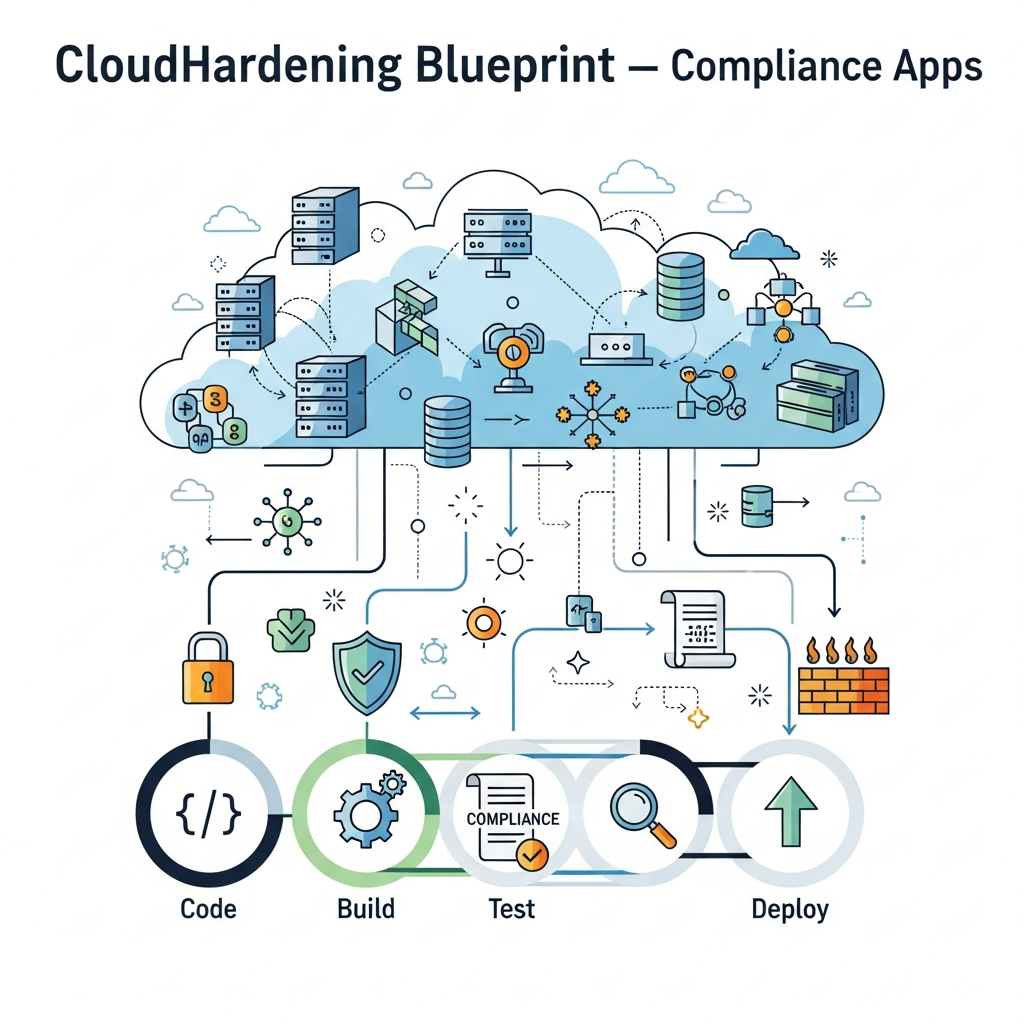
Cloud Hardening Blueprint — Compliance DevOps Apps
Regulated industries such as FinTech, healthtech, defense, and government-adjacent sectors cannot treat cloud security as an afterthought. Security controls, governance, and audit readiness must be embedded into the DevOps workflow from day one. This blueprint provides a practical path to cloud security compliance while accelerating delivery. We cover a concrete hardening checklist, how to design a robust DevSecOps pipeline, and how to align with AWS and Azure best practices along with common regulatory mappings.
Cloud security compliance in DevOps is not merely about ticking boxes. It requires integrating security controls, governance, and auditable evidence into the development lifecycle. When done right, security becomes a driver of faster releases, safer production environments, and stronger alignment with regulatory expectations.
Why DevSecOps Matters for Regulated Applications
DevSecOps extends traditional DevOps by weaving security into every phase of software delivery. In regulated domains, the cost of noncompliance can be substantial, ranging from fines and remediation expenses to reputational damage. A mature DevSecOps approach enables:
- Automated security testing that runs at every commit and build, catching issues early.
- Continuous compliance evidence generation for audits, board reviews, and regulatory reporting.
- Secure infrastructure as code, reducing drift between intended and actual configurations.
- Safer software supply chains through SBOMs and trusted image provenance.
Shifting security left shortens the blast radius of incidents and speeds up detection and remediation. For regulated apps, this translates into demonstrable control maturity and a clearer path to passing audits.
Cloud Hardening Checklist: Core Controls
A structured checklist forms the backbone of a compliant cloud posture across AWS and Azure environments. Use the items below as a baseline and tailor them to your regulatory regime and data classification scheme.
Identity and Access Management (IAM)
Enforce least privilege, role-based access, and just-in-time elevation. Maintain separate admin and non-admin accounts, enforce MFA, and implement strong authentication policies. Regularly review permissions and remove unused accounts. Consider automated access certification workflows to sustain ongoing compliance. Implement Just-In-Time (JIT) access for elevated tasks and enforce time-bound approvals for sensitive roles.
Network Security and Segmentation
Segment networks into well-defined zones, apply security groups and network ACLs with explicit allow rules, and minimize exposure of management interfaces. Use private subnets for sensitive workloads and enforce strict egress controls. Implement bastion hosts for administrative tasks and monitor access patterns continuously. Deploy micro-segmentation to limit lateral movement in production environments.
Data Protection and Encryption
Encrypt data at rest and in transit with industry-standard algorithms. Manage encryption keys via centralized services and enforce automatic key rotation. Apply data classification to assign the right protection level to different data types (PII, PHI, financial data, confidential business information). Ensure key ownership is auditable and that key access is logged and reviewed.
Secrets and Key Management
Store credentials, API keys, and access tokens in dedicated secrets managers. Enforce automated rotation and revoke credentials when they are no longer needed. Avoid embedding secrets in code or configuration files, and use ephemeral credentials where possible. Implement access controls that prevent secrets from appearing in logs or error messages.
Logging, Monitoring, and Audit Trails
Centralize logs and retain them for regulatory-relevant periods. Enable tamper-evident storage and immutable log archives. Implement alerting for anomalous activities and ensure audit trails cover access, changes, and deployments across all environments. Correlate events across identity, network, and data layers to surface threats quickly.
Data Residency, Privacy, and Compliance Mapping
Document where data resides, how it is processed, and who has access. Map data flows to regulatory controls and ensure data handling aligns with HIPAA, FERPA, GDPR, or other applicable regimes. Maintain a data catalog and lineage to support audits and regulatory inquiries.
Incident Response and Recovery
Define playbooks for common incident types, designate a security incident response team, and test response plans in production-like environments. Include recovery objectives, runbooks, and regular tabletop exercises. Ensure backups are protected, recoverable, and tested under realistic ransomware scenarios.
Designing a DevSecOps Pipeline
A robust DevSecOps pipeline embeds security into the CI/CD lifecycle, from code commit to production. Build it to be automated, auditable, and observable across all stages. The pipeline should enforce policy as code, guardrails, and continuous verification of compliance requirements.
Shift-Left Security in CI/CD
Integrate static application security testing (SAST) and software composition analysis (SCA) early in the pipeline. Validate code against secure coding standards before integration tests. Use pre-commit hooks to halt builds on critical findings, and require remediation before proceeding. Pair SAST with dynamic testing at later stages to catch runtime issues early.
Infrastructure as Code (IaC) Security and Policy as Code
Treat infrastructure definitions as code and continuously scan IaC templates for misconfigurations. Enforce policy-as-code with guardrails that prevent insecure deployments. Maintain an auditable policy library aligned to your regulatory framework. Use automated tests that validate security posture after IaC changes.
Container and Supply Chain Security
Scan container images for vulnerabilities, enforce image provenance, and pin to trusted registries. Use image signing and runtime protection to prevent tampered workloads from running in production. Establish a secure software supply chain by validating SBOMs and enforcing minimum acceptable vulnerability levels before promotion to production.
Secrets Management and Credential Rotation
Automate Secrets provisioning, rotate credentials on a schedule or in response to threat signals, and ensure secrets never appear in logs or error messages. Centralize access to sensitive data with strict access controls and robust auditing.
Automation for Compliance Evidence
Automatically generate evidence artifacts for audits, including change histories, test results, and policy decisions. Maintain a centralized repository of artifacts auditors can inspect with ease. Use versioned, time-stamped documentation to demonstrate ongoing compliance over time.
AWS and Azure Best Practices for Compliance
Both AWS and Azure offer a broad set of security services designed to support compliance programs. When applied correctly, these services reduce risk and simplify audit readiness. Align these practices with your regulatory mappings and your organizational risk appetite.
Identity and Access Management in the Cloud
Adopt centralized identity providers, enforce MFA for all privileged access, and implement conditional access policies. Employ role-based access and automatic credential rotation for service accounts. Use least-privilege permissions by default and regularly review access grants.
Threat Detection and Monitoring
Enable threat detection services and security analytics, route security logs to a centralized SIEM, and establish runbooks for incident response. Use anomaly detection to surface subtle breaches early. Implement automated response playbooks to reduce mean time to containment.
Data Protection and Key Management
Leverage managed key services with automated rotation and clear ownership. Ensure data at rest and in transit is encrypted, with auditable key usage. Maintain separation of duties between data owners and key custodians, and log all key events for audits.
Compliance-Specific Features
Use provider-specific controls that map to frameworks such as NIST 800-53, SOC 2, HIPAA, and ISO 27001. Build continuous compliance checks into the pipeline and automate reporting for audits. Maintain a repository of compliance artifacts and evidence that auditors can review efficiently.
Regulatory Frameworks and Mapping
Effective cloud security compliance requires translating regulatory requirements into concrete technical controls. The most common mappings include:
- NIST 800-53 and CIS Benchmarks for baseline security controls and configuration baselines.
- SOC 2 for service organization control transparency and a disciplined control environment.
- HIPAA and HITECH for health data protection, access controls, and audit capabilities.
- ISO 27001/27002 for a management system approach to information security and risk governance.
Mapping controls to the cloud involves documenting evidence pipelines, ensuring continuous monitoring, and producing automated audit artifacts. The objective is to make compliance an ongoing capability rather than a periodic activity.
Implementation Roadmap: A 12-Step Guide
- Define scope and regulatory requirements for your regulated apps. Create an inventory of data types, processing activities, and applicable controls.
- Establish a governance model with a security champion and an integrated DevSecOps owner. Define roles, ownership, and a cadence for reviews.
- Perform a current-state assessment of IAM, network segmentation, data flows, and logging. Identify gaps and risk ratings by domain (identity, data, network, apps).
- Implement a cloud hardening baseline (identity, network, data, secrets). Create a minimal viable baseline that can be scaled across environments.
- Adopt IaC security practices and policy as code, starting with a pilot environment. Extend to production with guardrails and automated testing.
- Integrate SAST/DAST, SCA, and container scanning into CI/CD pipelines. Ensure remediation workflows are defined and trackable.
- Set up centralized logging, monitoring, and alerting with auditable retention periods. Use a unified schema for events to ease analysis.
- Establish continuous compliance checks and automated evidence generation. Generate periodic audit-ready reports and dashboards.
- Define incident response playbooks and run tabletop exercises. Validate runbooks under realistic scenarios and improve them after drills.
- Align with provider-native security services for ongoing hardening and threat intelligence. Integrate threat intel feeds into detection and response workflows.
- Iterate on governance with regular audits and third-party assessments. Use audit findings to close gaps and tighten controls.
- Scale the program across all regulated apps with a standardized playbook. Reuse patterns, templates, and guardrails to accelerate deployment.
Measurement, Governance, and Continuous Improvement
Security and compliance are ongoing journeys. Establish key performance indicators (KPIs) such as time-to-remediate, mean time to detect (MTTD), mean time to recover (MTTR), audit readiness score, and percentage of critical vulnerabilities remediated in each sprint. Implement a quarterly governance cadence that reviews policy changes, control effectiveness, and evidence quality. Use dashboards that translate technical findings into business risk terms for leadership visibility. Regularly publish progress reports to the executive team and the board to demonstrate continued improvement.
Common Pitfalls and How to Avoid Them
- Over-scoping security controls without considering practical delivery constraints. Mitigation: use phased hardening with measurable milestones and a rolling backlog rooted in risk.
- Treating compliance as a one-time project rather than an ongoing capability. Mitigation: automate evidence generation and embed controls in CI/CD and IaC pipelines.
- Relying on point-in-time scans without continuous monitoring. Mitigation: integrate real-time security telemetry and automated remediation hooks.
- Neglecting data sovereignty and residency requirements. Mitigation: explicitly document data flows and use region-specific configurations and data localization controls.
Next Steps: From Assessment to Action
If you are leading a regulated cloud program, begin with a practical, vendor-agnostic assessment to identify gaps and prioritize fixes that yield the biggest risk reduction first. Build a roadmap that blends people, processes, and technology changes, with a strong emphasis on automation and auditability. A security-first DevOps approach can turn compliance from a burden into a competitive advantage.
For organizations seeking a guided path, engage a partner with proven experience in cloud security, DevSecOps, and regulated industries to accelerate progress. The goal is not merely to pass audits but to sustain a defensible security posture that scales with your business and supports long-term innovation.