
Offshore-Contract: IP SLAs Governance
- all
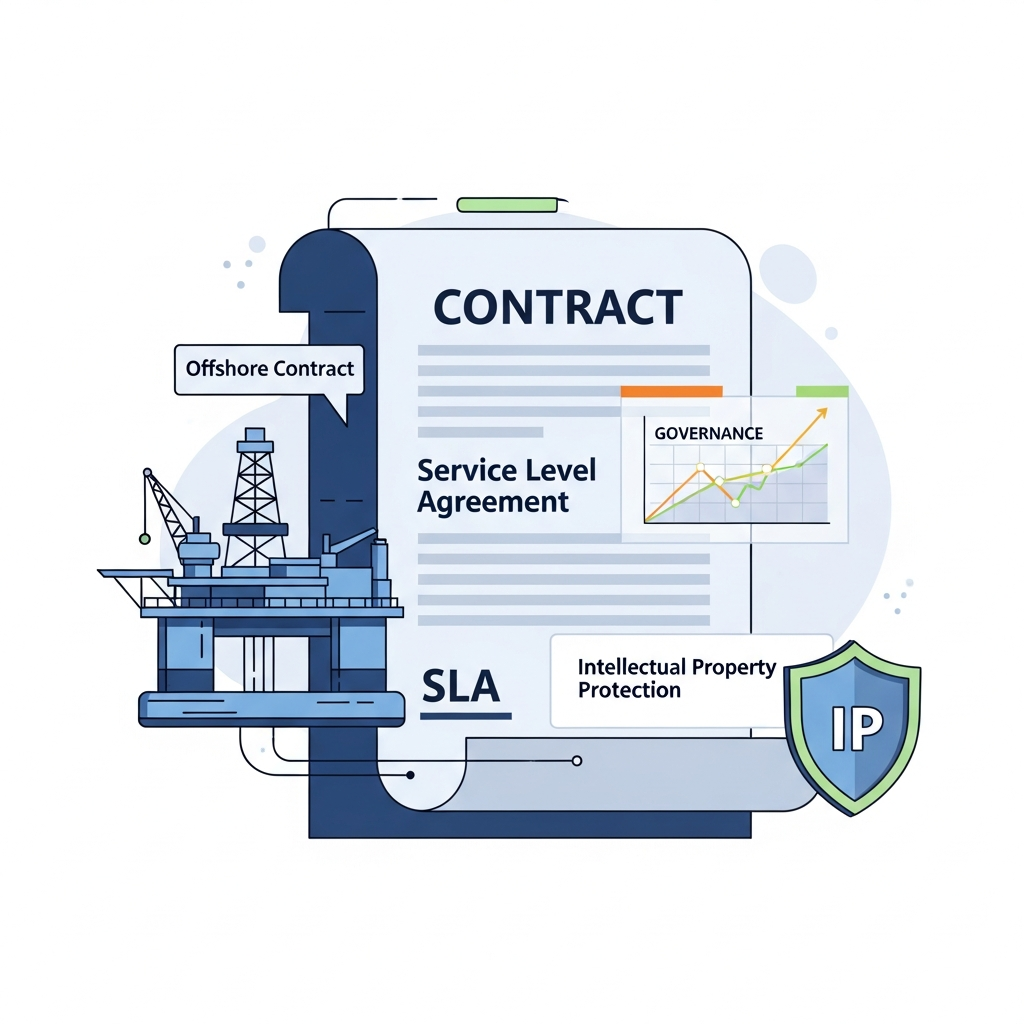
Offshore Development Contract: IP SLAs Governance
Overview and Objectives
An offshore development contract is more than a procurement document. It is a governance framework that defines how intellectual property (IP) is created, who owns it, how performance is measured, and how security risks are mitigated when teams operate across borders. A well crafted contract aligns business outcomes with legal protections, while providing clarity for engineers, product managers, and executives on both sides of the arrangement.
In practice, offshore engagements revolve around three pillars: IP governance, performance governance via SLAs, and organizational governance that ensures accountability across distributed teams. Together, these pillars reduce rework, accelerate time-to-market, and lower the risk of IP leakage or misalignment with regulatory requirements.
Core IP Protection Clauses
IP protection should be baked into the contract from day one. The goals are to secure ownership of deliverables, protect background IP, and establish clear pathways for licensing, use, and exit. Below are the central clauses every offshore contract should consider.
1) Ownership of Deliverables
Deliverables produced under the contract should vest in the Client, subject to applicable law. A typical clause states that Deliverables are works made for hire where permissible, or alternatively, the Client receives all rights, title, and interest in Deliverables upon payment completion. Include a fallback provision that ensures ownership transfers even if a jurisdiction does not recognize a specific form of work-for-hire protection.
2) Background IP and Background Materials
Background IP remains with its owner. The contract should identify background materials contributed by the contractor and license them to the Client solely for the Project, with restrictions to prevent reuse in unrelated products. Use a limited, non-exclusive, royalty-free license for the duration of the engagement, expressly tied to the Deliverables and restricted to the purposes of the Project.
3) Inventions and Improvements
Clarify who owns any improvements or new IP created during the engagement. A common approach is to assign newly developed IP to the Client, with an express waiver of any rights by the contractor on improvements conceived in the course of the project. Include a provision for joint development where applicable, specifying ownership percentages and license terms.
4) Source Code Escrow and Repos
Source code escrow protects the Client in case the contractor defaults or fails to meet obligations. Place the source code in escrow with an independent third party, with conditions for release upon defined triggers such as material breach, insolvency, or failure to deliver critical milestones. Outline repository access rights, frequency of updates, and integrity checks.
5) Open Source and Third-Party Components
Mandate disclosure of all open source components. Require compliance with licenses and a warranty that the use of third-party libraries will not infringe third-party rights. Include a process for handling vulnerabilities and updates to open source components during the engagement.
6) Assignment and Change of Control
Include an assignment clause that binds successors and assigns, ensuring continuity of IP rights if the contractor changes control or ownership. A typical clause requires notice and guarantees that the new entity assumes all obligations under the agreement.
7) Confidential Information and Trade Secrets
Confidential information should be clearly defined, with scope extending to source code, architecture diagrams, and business-sensitive data. Include restrictions on disclosure, permitted disclosures to affiliates, and a defined post-termination confidentiality period.
SLA Template and Metrics
A robust SLA translates business expectations into measurable performance. It should cover availability, responsiveness, issue resolution times, and performance monitoring. The goal is to align incentives, provide transparency, and enable objective remediation when service levels degrade.
1) Service Levels and Targets
Define key metrics such as uptime, mean time to recovery (MTTR), and response times by severity. For example, critical issues should be acknowledged within 15 minutes and resolved within 4 hours, with a strict escalation path if resolution slips.
2) Monitoring and Reporting
Specify how performance is measured, the tools used, and the cadence of reports (for example, weekly dashboards and monthly formal reviews). Ensure there is a process for auditing and anomaly detection, with clear owner responsibilities.
3) Escalation and Remedies
Outline a multi-tier escalation procedure, including contact points, times to respond, and the types of remedies available, such as service credits or milestone re-scopes. Attach a schedule of service credits linked to performance gaps.
4) Change Management and SLA Updates
Include a formal change mechanism to adjust SLAs as project scope evolves. Require written amendments and a minimum notice period prior to any SLA revision.
Offshore Governance Model
Governance is the backbone that ensures accountability, transparency, and alignment across distributed teams. A practical model combines strategic oversight, tactical project governance, and operational discipline.
1) Governance Cadence
Establish a regular rhythm: executive steering every quarter, program management reviews monthly, and operational standups twice weekly. Each cadence should produce action items, risk logs, and updated roadmaps for stakeholder visibility.
2) Roles and Responsibilities
Key roles include a Client Sponsor (senior business owner), a Program Manager (day-to-day governance), and a Vendor Delivery Lead (owner of the offshore team). Define explicit decision rights, escalation paths, and acceptance criteria for deliverables.
3) Governance Artifacts
Maintain a governance dossier comprising the project charter, RACI matrix, risk register, change log, security policy, and compliance checklist. These artifacts create an auditable trail of governance for both sides.
Data Security and Compliance
Data security obligations are non-negotiable in offshore engagements, particularly when handling sensitive intellectual property, customer data, or regulated information. A sound contract requires concrete security controls and audit readiness.
1) Data Handling and Separation
Specify how data is stored, transmitted, and accessed. Strategies include role-based access control (RBAC), data minimization, and data segmentation to prevent cross-tenant leakage across offshore environments.
2) Encryption and Key Management
Mandate encryption for data at rest and in transit, plus secure key management practices. Define who holds keys, rotation schedules, and incident response protocols for any compromised keys.
3) Incident Response and Notification
Detail a breach notification window, the contact chain, and remediation steps. Include regulatory notification requirements if applicable and coordinate with legal counsel for timely disclosure.
4) Compliance Frameworks
Align with applicable frameworks such as SOC 2, ISO 27001, PCI-DSS, HIPAA, or FERPA as relevant to the data domain. Include third-party audit rights and remediation timelines for non-conformities.
Practical Implementation and Templates
The practical flavor of offshore contracts comes from concrete language, milestone-based deliverables, and clear guardrails. The following templates and language snippets are intended as starting points for discussions with your vendor and legal counsel.
Sample Clause: IP Ownership
"All Deliverables created under this Agreement shall be the sole property of the Client. To the extent permitted by applicable law, Deliverables shall be considered works made for hire. If Deliverables do not qualify as works made for hire, Contractor hereby assigns all right, title, and interest in the Deliverables to Client upon full payment for the Deliverables."
Sample Clause: Background IP License
"Contractor retains ownership of its Background IP. Client is granted a non-exclusive, non-transferable license to use Background IP solely for the purpose of receiving and using the Deliverables under this Agreement."
Sample Clause: Source Code Escrow
"Deliverables shall be deposited into an independent escrow agent. Release of the escrowed materials shall occur upon defined triggers including Contractor insolvency, material breach, or failure to maintain required performance levels, as set forth in the escrow agreement."
Sample Clause: Data Security
"Contractor shall implement and maintain administrative, physical, and technical safeguards appropriate to the sensitivity of the data. All data shall be encrypted at rest and in transit, with access controlled by RBAC. Contractor shall notify Client of any data breach within 72 hours of discovery."
Template: Change Management
"All changes that affect scope, schedule, or cost shall be documented in a written Change Order, approved by authorized representatives of both parties, and tracked in the project repository with a revised milestone plan."
Risk Management and Pitfalls
Outsourcing to offshore teams introduces unique risks. Proactive planning helps avoid rework, misaligned expectations, and security incidents. Use the following checklist to mitigate common pitfalls.
- Define acceptance criteria early and tie them to measurable milestones.
- Implement regular security assessments and patch management schedules.
- Establish a clear exit plan, including IP return and data deletion requirements.
- Ensure governance cadence covers both business outcomes and technical health metrics.
- Include clear escalation paths and documented remedies for SLA breaches.
Roadmap to Implementation
Turning governance principles into practice requires a phased approach. Consider the following four-step roadmap to implement an IP and SLA governance framework for offshore engagements.
Step 1: Align and Charter
Draft a joint charter that outlines objectives, success metrics, risk tolerance, and governance roles. Obtain executive sponsorship and ensure legal alignment across jurisdictions.
Step 2: Lock Down IP and Security
Agree on IP ownership, background IP licenses, escrow arrangements, and data security controls. Attach a security annex detailing encryption, access controls, and incident response.
Step 3: Codify SLAs and Delivery Cadence
Publish SLAs, monitoring tools, reporting templates, and escalation matrices. Establish regular governance meetings and a risk register with owners and due dates.
Step 4: Test, Iterate, and Scale
Run pilot projects to validate the model, collect feedback, and refine clauses. As comfort grows, scale the governance model to multiple product streams or offshore teams.