
Offshore-Development-Center Governance Playbook
A framework for predictable offshore delivery
- Offshore Development
- Software Scaling
- Delivery Model
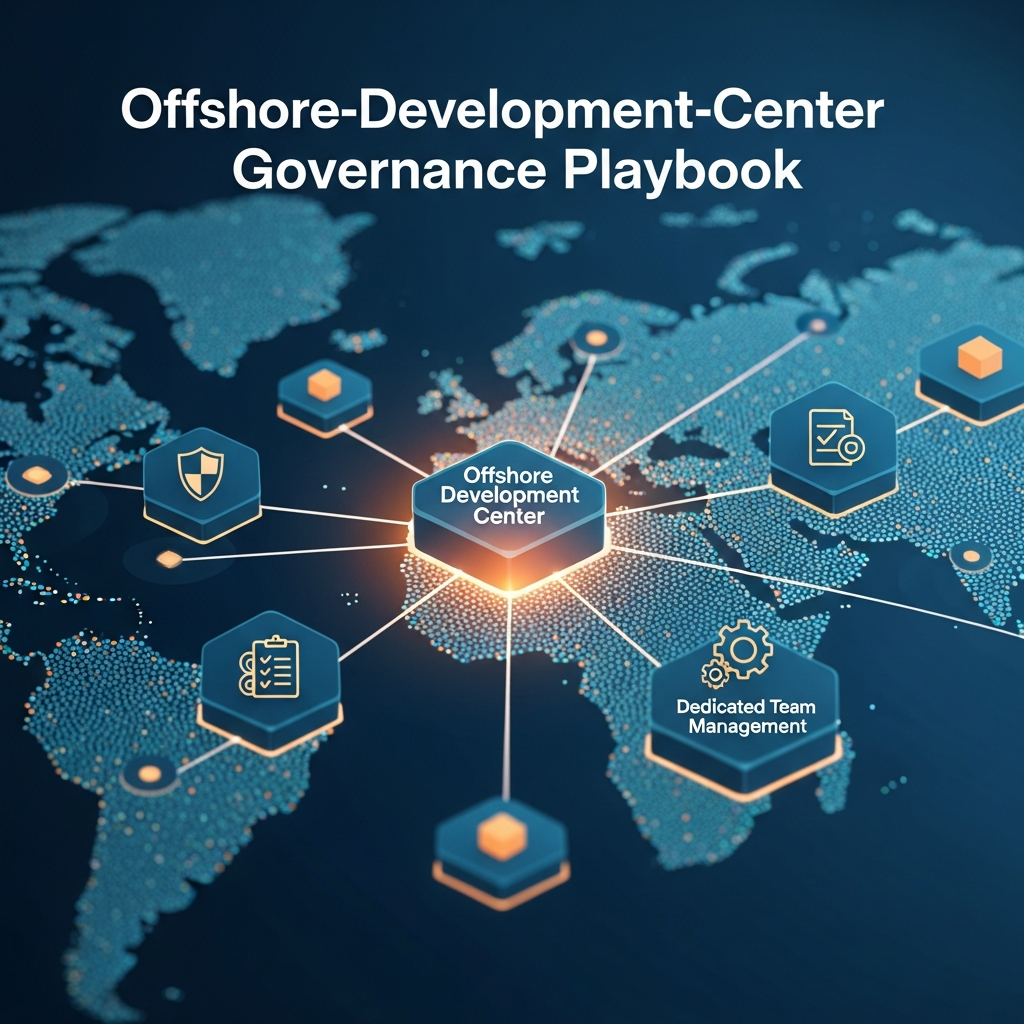
Offshore Development Center Governance Playbook: A Practical Guide for Predictable ROI and Low Vendor Risk
What is Offshore Development Center Governance?
Offshore development center (ODC) governance is the set of policies, structures, and practices that regulate how an offshore team contributes to product delivery. It encompasses organizational design, risk management, performance measurement, and continuous improvement. Effective ODC governance aligns vendor capabilities with business goals, ensuring that offshore teams deliver predictable ROI while maintaining high quality and compliance standards.
For technology leaders, governance is not a one-time exercise. It is an ongoing discipline that covers strategic planning, vendor relationships, contract incentives, and operational cadence. The right governance model makes remote delivery feel seamless, with clear ownership, transparent reporting, and measurable outcomes.
This playbook focuses on governance patterns that work across industries, with emphasis on dedicated development teams, SLA-driven performance, and secure collaboration with offshore partners. It is designed to help CTOs, VPs of Engineering, and product leaders make informed decisions when evaluating offshore delivery models.
A Practical Governance Framework
A robust governance framework consists of four interlocking domains: strategic alignment, operating model, governance ceremonies, and performance analytics. Each domain reinforces the others, creating a cycle of alignment, execution, review, and refinement.
1) Strategic alignment
Start with a formal charter that ties the offshore center to the company’s strategic objectives. Document the target outcomes, required capabilities (for example, frontend, backend, data analytics, security), and the constraints around budget, time zones, and legal compliance. Make sure governance outcomes map directly to business KPIs like time-to-market, defect rates, and uptime.
2) Operating model
Define the operating model for the offshore center, including organizational interfaces, decision rights, and escalation paths. Decide on a dedicated development team model versus a blended offshore/onshore approach, and specify how product owners, scrum masters, and vendor managers collaborate. In practice, this means clear roles, defined handoffs, and a cadence that mirrors in-house delivery cycles.
3) Governance ceremonies
Standardize ceremonies such as quarterly governance reviews, monthly performance dashboards, and weekly operational stand-ups. Use these rituals to surface risks early, adjust scope, and reallocate capacity. Each ceremony should produce actionable outcomes, not just status updates.
4) Performance analytics
Implement a lightweight analytics layer that captures delivery velocity, defect leakage, SLA adherence, and security/compliance metrics. Regularly benchmark against internal targets and adjust governance rules as needed. Transparent dashboards foster trust with leadership and stakeholders across the organization.
Offshore Vendor Management: Selecting and Managing Partners
Vendor management is the heartbeat of ODC governance. A deliberate vendor selection process reduces risk and improves predictability. Start by defining evaluation criteria that matter most to your business: technical depth, domain experience, security posture, compliance capabilities, time-zone compatibility, and cultural alignment.
Key steps include issuing a focused RFP or request for information, conducting structured due diligence, and running proof-of-concept sprints to validate critical paths. Once you select a partner, formalize governance through a joint operating agreement that codifies roles, reporting lines, and decision rights. This arrangement should explicitly address how changes are requested, approved, and prioritized.
Governance benefits improve when there is clear accountability for offshore vendor management. Assign a dedicated vendor manager who acts as the single point of contact for the partner, handles contract governance, and maintains the performance scoreboard. The vendor manager should coordinate with the internal product and security teams to ensure alignment and timely feedback.
SLA Governance for Offshore Teams
Service level agreements (SLAs) are the contract-side counterpart to governance. They translate expectations into measurable commitments and provide a framework for enforcement. A strong SLA regime covers delivery, quality, security, and operational reliability.
Delivery-focused SLAs typically include metrics such as sprint velocity, story completion rate, defect rate per release, and mean time to repair (MTTR) for critical incidents. Quality SLAs can measure test coverage, automated test pass rates, and security scanning results. Security and compliance SLAs should mandate regular audit results, vulnerability remediation times, and data handling standards.
To maximize effectiveness, pair SLAs with dashboards that stakeholders can access in real-time. Establish escalation paths for SLA breaches and define corrective action plans that automatically trigger when thresholds are approached. Use SLAs not just as penalties, but as a framework for continuous improvement and accountability.
Security, Compliance, and Risk Management
Governance cannot succeed without a rigorous approach to security and regulatory compliance. Offshore teams introduce unique risk vectors, including data sovereignty, access control, and incident response coordination across borders. Build a security-first governance posture that treats security as a shared responsibility between your organization and the offshore partner.
Key practices include adopting a secure software development lifecycle (SSDLC), enforcing role-based access control, implementing multi-factor authentication, and conducting regular third-party risk assessments. Data protection requirements should be explicit, with encryption at rest and in transit, and robust data governance policies for data retention and deletion.
In regulated industries, security and compliance are non-negotiable. Align governance with industry standards such as ISO 27001, SOC 2, and relevant sector-specific regulations. Make audit readiness a continuous discipline by maintaining evidence of compliance testing, remediation actions, and security training for the offshore team.
Delivery Models and Architecture
ODC governance must accommodate different delivery models while preserving control and visibility. Common models include dedicated development teams, staff augmentation, and managed offshore delivery centers. Each model has trade-offs in cost, control, and speed, so choose based on strategic needs and risk tolerance.
Architecturally, consider API-first backends, modular microservices, and containerized deployments to enable scalable, predictable releases. A well-governed offshore center should integrate with your CI/CD pipelines, security scanning, and compliance tooling. Design for future scale by ensuring service ownership and clear domain boundaries between in-house and offshore components.
Communication patterns matter. Define preferred channels, response times, and documentation standards to prevent misalignment. Consider time-zone overlap windows that maximize collaboration while preserving productivity for your teams.
Implementation Playbook: From Planning to KPIs
Transitioning to an offshore delivery model should follow a disciplined, phased approach. Phase 1 focuses on readiness: define governance scope, select a partner, and establish the first set of SLAs. Phase 2 emphasizes onboarding: align teams, set up BDARs (baseline data, architecture reviews, risk assessments), and implement initial dashboards. Phase 3 centers on optimization: measure outcomes against KPIs, adjust capacity, and expand the scope of the offshore center.
Phase 1: Readiness
Document the business case, target ROI, and key performance indicators. Create a governance charter that spells out decision rights, risk tolerance, and escalation paths. Select a pilot project that demonstrates core capabilities without risking strategic systems.
Phase 2: Onboarding
Establish the offshore team's operating rhythms, sprint cadences, and documentation standards. Implement initial security controls and data handling rules. Build a shared knowledge base that captures decisions, design choices, and lessons learned from the pilot.
Phase 3: Optimization
Scale the partnership by expanding the offshore footprint, refining SLAs, and optimizing the cost-to-delivery ratio. Use retrospectives to drive continuous improvement and adjust governance structures to reflect evolving business priorities.
Common Pitfalls and How to Avoid Them
Gaps in governance tend to surface as misaligned incentives, opaque reporting, or unclear ownership. The most common pitfalls include underestimating security requirements, overcomplicating vendor governance, and failing to maintain single-thread accountability for critical outcomes.
Mitigate these risks with a clear RACI (Responsible, Accountable, Consulted, Informed) model, lightweight but rigorous SLAs, and regular executive governance reviews. Avoid ambiguous return-to-office expectations; instead, codify remote collaboration norms and performance incentives that align with the client’s ROI targets.
Finally, ensure there is a defined exit plan. Governance works best when both sides understand how to end or renew arrangements with minimal disruption. An explicit exit strategy reduces vendor risk and maintains business continuity through transitions.
Measuring ROI and Success
Governance is not merely about control; it is about delivering measurable business value. Track ROI by comparing the total cost of ownership (TCO) of offshore delivery against the incremental value from faster time-to-market, higher quality releases, and improved system reliability. Use a balanced scorecard that blends financial outcomes with operational metrics and customer impact.
Key indicators include cycle time reduction, defect leakage rate, deployment frequency, uptime, and security audit pass rates. Regularly publish KPI results to leadership and stakeholders to reinforce the value of governance investments and to justify ongoing offshore partnerships.
Conclusion: A Practical Path to Predictable Delivery
Governance is the compass that keeps offshore development efforts aligned with business goals. A well-structured offshore development center governance program delivers predictable ROI, reduces vendor risk, and supports rapid, secure, and compliant software delivery. By combining a clear governance framework, disciplined vendor management, robust SLA governance, and rigorous security practices, technology leaders can harness offshore delivery as a strategic advantage rather than a cost center.
As you embark on building or refining your ODC governance, focus on practical steps: define a charter, choose a partner with the right capabilities, implement SLAs that drive performance, and embed security into every phase of the lifecycle. The payoff is not just lower risk; it is faster, higher-quality software that scales with your business.