
SaaS Launch Roadmap: Validate an MVP and Reach Your First 1,000 Users
- all
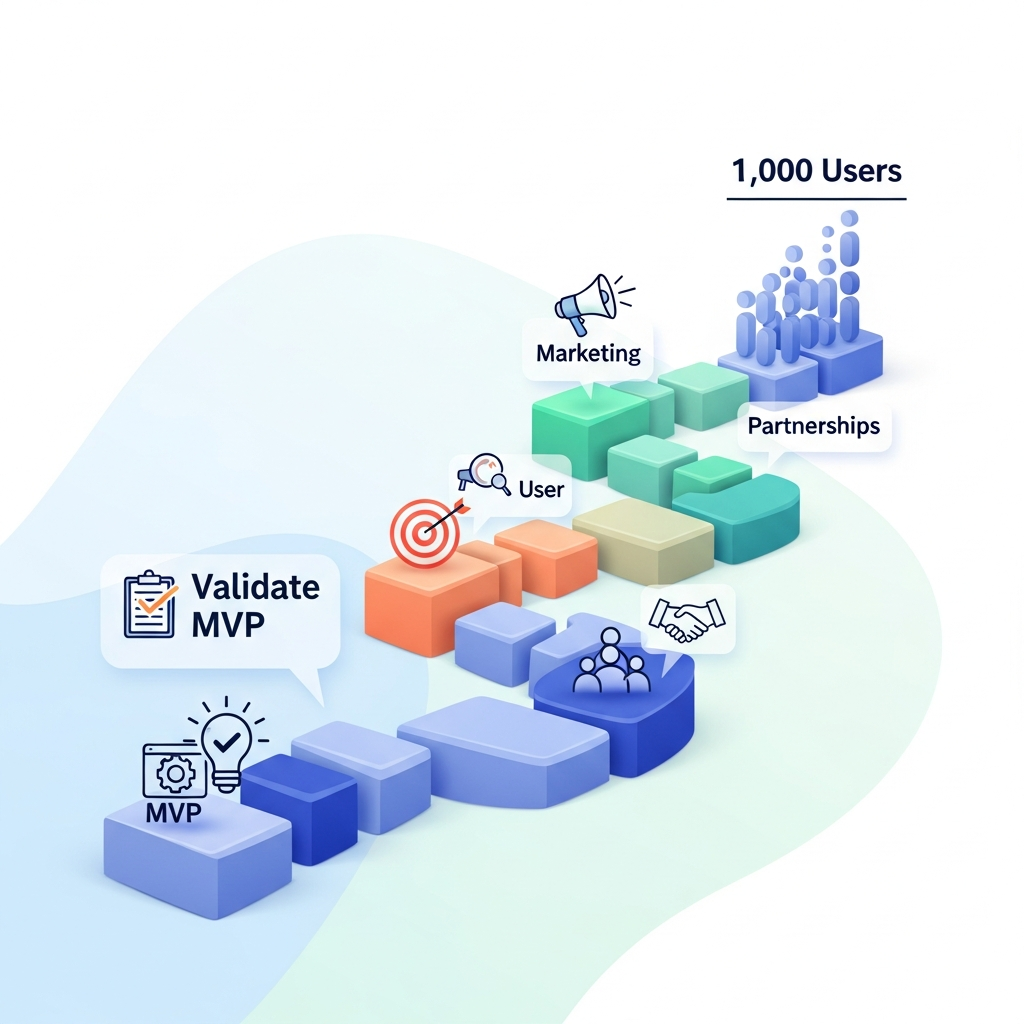
SaaS Launch Roadmap: Validate an MVP and Reach Your First 1,000 Users
Framing the SaaS Launch Roadmap
Launching a SaaS product is a structured journey, not a single sprint. A solid SaaS launch roadmap starts with a clear definition of success, a focused MVP scope, and realistic milestones aligned to customer value. The aim is to validate critical assumptions about the problem, the solution, and the willingness to pay before scaling.
Begin by identifying your target ICP (ideal customer profile) and the top 3 use cases that deliver the most measurable impact. A compact roadmap helps teams stay aligned across product, design, marketing, and sales. It also makes it easier to prioritize experiments and learn rapidly from real user feedback.
Think of the roadmap as a learning instrument. Each milestone should produce learnings that either confirm the path forward or signal a pivot. For early-stage SaaS startups, the objective is lean experimentation: minimal viable features, quick validation cycles, and data-driven decisions.
Key inputs to start
- Well-defined ICP and customer problems you are solving.
- A concise MVP scope that delivers core value with minimal friction.
- A hypothesis stack covering value, pricing, and onboarding.
With these inputs, you can design a learning plan that maps to specific metrics and time-bound experiments. This disciplined approach reduces risk and accelerates time-to-value for your first 1,000 users.
MVP Validation Checklist: What to Validate and When
An MVP is not a rough draft; it is a controlled experiment to test riskiest assumptions. Use the checklist below to structure your validation process and keep teams focused on what truly matters at this stage.
- Define success criteria: Specify what signals will indicate a viable product, such as activation rate, retention after 14 days, or a paying customer within 30 days.
- Limit MVP scope: Include only the core feature set that delivers the promised value. Exclude adjacent features that complicate learning.
- Design testable experiments: For each assumption, create a discrete test with a measurable outcome and a clear pass/fail threshold.
- Instrument your product: Implement lightweight analytics, event tracking, and user flows to gather actionable data without slowing development.
- Establish a feedback loop: Build in fast customer interviews, surveys, and in-app feedback to capture qualitative insights.
- Decide the next step: Use data to decide whether to persevere, pivot, or pause and re-scope the MVP.
Examples of MVP validation tests include pricing experiments, onboarding flow A/B tests, and feature toggling to gauge demand without full investment. Remember, the goal is learning, not delivering a polished product at this stage.
Designing a Go-To-Market Strategy for SaaS Startups
A practical GTM strategy aligns product value with the buying journey. For SaaS startups, this means defining the market, messaging, pricing, and channels that accelerate early adoption while preserving unit economics.
Start with five core elements: ICP refinement, positioning and messaging, pricing and packaging, channel strategy, and predictive demand signals. Use a light pricing model at first to reduce friction and capture willingness to pay as you demonstrate value. A clear onboarding promise—what users get in the first 10 minutes—helps calibrate marketing and product experiments.
Channel selection should balance speed and cost. Content marketing, targeted product-led growth (PLG) experiments, partner ecosystems, and limited paid acquisition can all contribute to early momentum. Record key learnings from each channel to guide budget allocation and future experiments.
Pricing and packaging tips
- Offer a transparent, value-based pricing tier with a free or low-cost entry option.
- Separate features by need and adoption stage to reveal the most compelling value proposition.
- Track upgrade rates and the time-to-value to refine the pricing ladder over time.
Early User Acquisition Tactics That Scale
Acquiring early users is about quality, not just quantity. A deliberate mix of inbound and outbound tactics helps you assemble a cohort of engaged users who can validate product-market fit and provide feedback to improve the MVP.
Practical tactics include creating high-value content that educates your ICP, hosting micro-webinars or live demos, and partnering with complementary platforms for co-marketing. Referral programs, early-access invites, and beta communities can convert interested users into early adopters with low friction.
Paid strategies should be employed cautiously at this stage. Start with a small test budget, run cost-per-acquisition experiments, and focus on channels that demonstrate clear signal from user behavior. Pair paid tests with organic efforts to build a sustainable velocity.
Early experiments you can run this quarter
- Content series on use cases that demonstrate outcomes your ICP cares about.
- Product-led onboarding experiments to reduce time-to-first-value.
- Strategic partnerships with tools or platforms frequented by your ICP.
Activation, Onboarding, and First 1,000 Users Metrics
Activation is the moment a user realizes value. For a SaaS MVP, the activation funnel typically consists of account creation, initial setup, and first meaningful outcome (the user’s first successful task in your product).
Onboarding should be frictionless, with guided tours, contextual help, and an emphasis on quick wins. Track metrics like time-to-value, activation rate, and drop-off points in the onboarding flow. Use cohort analysis to observe how new users perform as you iterate on the onboarding experience.
To reach the first 1,000 users, align onboarding improvements with the most important value metrics. Quick wins such as simplified sign-up, in-app prompts for key actions, and an obvious first-task path can dramatically improve retention and long-term engagement.
Key activation metrics to monitor
- Time-to-First-Value (TTFV)
- Activation rate (users completing the first meaningful action)
- Daily/weekly active users after onboarding
Measuring Product-Market Fit Metrics
Product-market fit is demonstrated by engagement, retention, and willingness to pay. Track a core set of PMF metrics that reveal whether your product delivers sustainable value to your target customers.
Consider metrics such as retention by cohort, churn rate on the core plan, net revenue retention, and propensity-to-pay signals. Use qualitative feedback alongside these numbers to understand why users love or resist your product. A single north-star metric, supported by leading indicators, helps you steer the MVP toward a scalable growth path.
Periodically revisit your PMF assessment as you add features or pivot based on learnings. A well-managed PMF trajectory reduces risk when expanding to new segments or geographies.
Roadmap Example: A 12-Week MVP Validation Plan
The following is a practical, week-by-week scaffold you can adapt. It emphasizes iterative learning, rapid experiments, and disciplined data collection to support a go/no-go decision at the end of the period.
- Weeks 1–2: Discovery and hypothesis framing — articulate the problem, finalize ICP, and write testable hypotheses about value, pricing, and onboarding. Define success criteria and the data you will collect.
- Weeks 3–4: MVP scope and initial build — implement core value delivery with lightweight design. Set up analytics and user feedback loops. Prepare outreach for early adopters.
- Weeks 5–6: Customer experiments — run onboarding and pricing experiments with a small cohort. Collect qualitative feedback and quantify early usage signals.
- Weeks 7–8: Acquisition push — initiate targeted outreach to the ICP, launch content and demos, and monitor channel performance. Adjust messaging based on responses.
- Weeks 9–10: Data review — analyze activation, retention, and willingness-to-pay signals. Identify any pivot opportunities and refine the MVP scope if needed.
- Weeks 11–12: Decision point — decide to persevere, pivot, or pause. Outline the plan for next-phase development, with a focus on scaling to 5,000 users or more if metrics justify it.
Throughout the 12 weeks, maintain a shared dashboard of your core metrics and a concise narrative of learnings. This makes it easier for stakeholders to assess progress and for teams to adapt quickly.
Note: The roadmap should remain flexible. The goal is purposeful iteration, not perfection on day one. Use the data you collect to guide the next round of experiments and investments.