
Selecting Offshore Partners - Governance Checklist CTOs
A CTO guide to offshore governance
- Offshore Development
- IT Outsourcing
- Software Operations
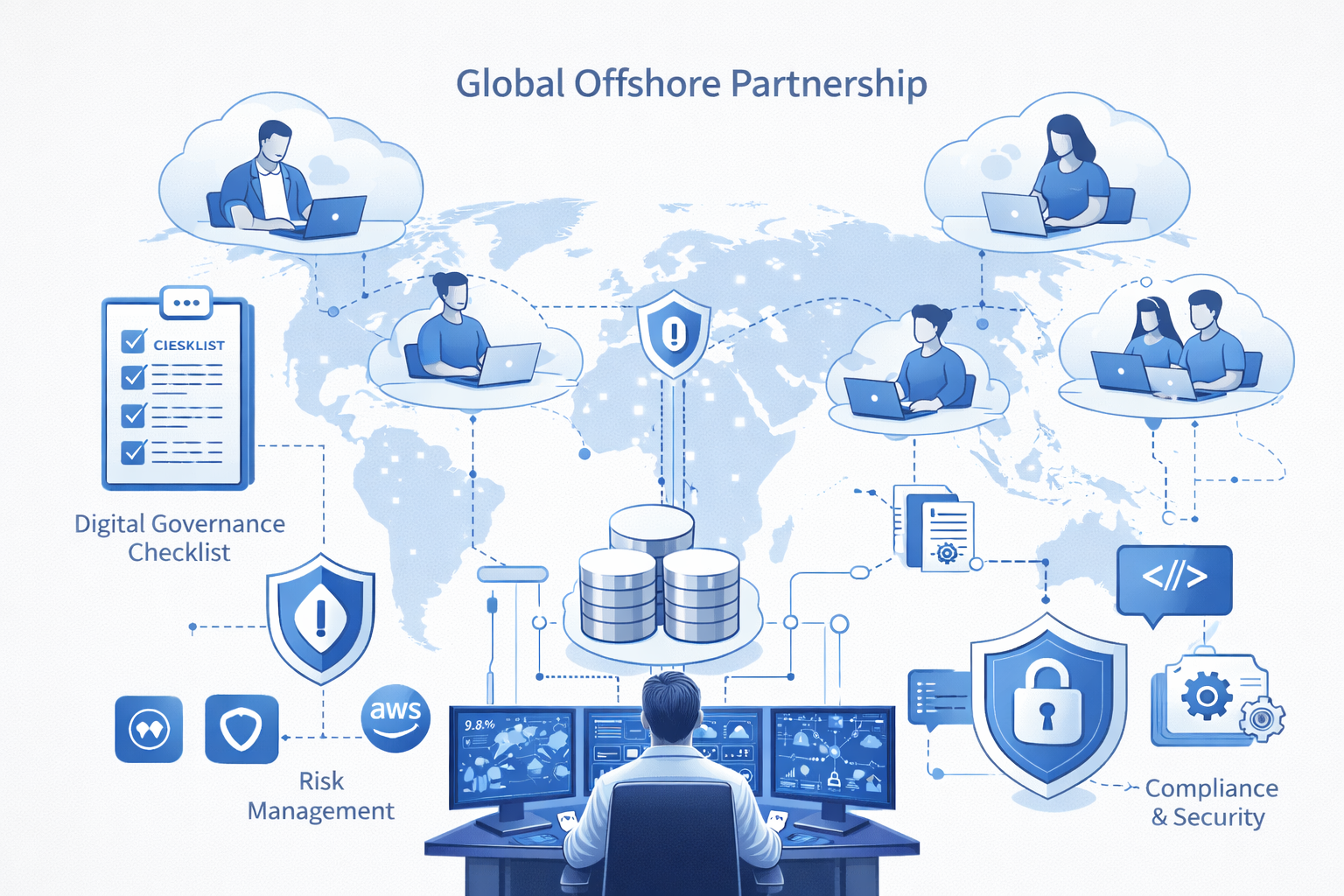
Selecting Offshore Partners — Governance Checklist CTOs
Governance foundations for offshore delivery
Governance is not a document you file away; it is the operating framework that ensures offshore delivery aligns with your strategic goals, risk tolerance, and regulatory requirements. A strong governance foundation begins with clear roles, decision rights, and escalation paths. It also defines how work is planned, how changes are approved, and how performance is measured over time.
In practical terms, governance translates into predictable budgeting, transparent milestones, and disciplined risk management. When CTOs demand offshore partners, they are really seeking a trusted operating model that can scale with their roadmap while preserving security and quality. This section outlines the core concepts you should establish before evaluating any vendor.
Key concepts to lock in early
- RACI or RASCI charts to assign Responsibility, Accountability, Support, Consultation, and Information sharing.
- Acceptance criteria that tie features to measurable outcomes and business value.
- Release governance to control when and how software goes into production.
Governance models you should consider
Offshore partnerships come in several governance flavors. Each model affects risk, cost, speed, and control. Your choice should reflect the nature of the product, regulatory constraints, and how much you want to insource or outsource decision-making.
Dedicated development team (DDT) model
The dedicated team model assigns a coherent, multi-disciplinary squad to work exclusively on your product. It behaves like an extended in-house team with defined sprint rituals, backlogs, and product deadlines. This model is ideal for long-running programs requiring deep domain knowledge and consistent output.
Pros include high alignment, predictable velocity, and ease of governance. Cons can include higher management overhead and the need for strong product ownership on your side to maintain direction.
Managed offshore center
In a managed center, the partner runs a full development facility that adheres to your governance standards but provides more autonomy. You gain scale and mature delivery practices while reducing day-to-day micromanagement. This model works well for organizations pursuing large, multi-product transformations.
Staff augmentation vs outcome-based engagement
Staff augmentation adds resources to your existing teams. It keeps control tightly in your hands and is cost-effective for short horizons. Outcome-based or fixed-price engagements, by contrast, focus on delivering business outcomes with defined success criteria and SLAs. Choose augmentation for flexibility; choose outcomes for accountability on business results.
Hybrid approaches
Many CTOs blend models by combining a core dedicated team with augmented specialists for spikes or specialized domains. Hybrid arrangements can balance control with speed, provided the governance framework explicitly covers handoffs, knowledge transfer, and integration points.
The vendor evaluation checklist
Evaluating offshore vendors is not a single scoring exercise; it is a process. Start with a long list of must-haves and progressively validate capabilities through documents, demonstrations, and pilot work. The checklist below covers the essential areas a CTO should scrutinize before contracting any offshore partner.
Security and compliance
Ask for security policies, certification attestations (where applicable), incident response timelines, and data handling procedures. Confirm that data storage and processing comply with relevant regulations (for example, PCI, GDPR, HIPAA, FERPA, or industry-specific standards). Request evidence of regular security training for personnel and secure coding practices.
Data governance and IP protection
Define how data ownership, access controls, and data segregation are handled. Ensure IP assignment and protection terms are crystal clear, with robust NDA protections and clear paths for exit or transfer of knowledge at project end.
Delivery capabilities and maturity
Review the partner’s delivery model maturity: how they plan, track, test, and release. Look for evidence of CI/CD, automated testing, code quality metrics, and a mature backlog management process. Ask for sample sprint plans and velocity metrics from recent engagements.
Quality assurance and testing practices
Quality assurance should be embedded early. Favor partners with test automation, code review rituals, and defect tracking aligned to your acceptance criteria. Verify how they handle performance, security, and resilience testing across environments.
Security controls and incident response
Request a concrete incident response plan, continuous monitoring, and a defined process for zero-trust access. Ensure there is a clear escalation path for security incidents and a post-incident review cadence.
Pricing, contract terms, and governance protections
Beyond rate cards, examine pricing stability, change control processes, terminations, and SLAs. Look for governance-oriented clauses that protect IP, data, and continuity of service during transitions.
References and case studies
Ask for references and measurable outcomes from prior engagements. Seek evidence of similar scale, regulatory contexts, or industry verticals to your own. Contact references to validate delivery quality and governance alignment.
SLAs that drive performance
Service level agreements (SLAs) formalize expectations and provide a mechanism to manage performance. A well-constructed offshore SLA reduces ambiguity and creates a structured path for remediation if service levels slip. The following guidance helps tailor SLAs to your governance needs.
What to include in an offshore SLA
- Response and resolution times by severity level for incidents and requests.
- Uptime commitments and disaster recovery objectives, with clear continuity plans.
- Release management and change control timelines, including emergency releases.
- Quality targets for defect rates, test coverage, and code quality gates.
- Access controls, data handling, and privacy commitments aligned to regulatory needs.
- Penalties, service credits, or remedies if thresholds are not met.
- Measurement methodologies, reporting cadence, and audit rights.
Operational and governance SLAs
Consider adding governance SLAs that specify cadence for steering committee meetings, risk reviews, backlog hygiene, and escalation protocols for strategic decisions. Tie governance SLAs to business outcomes so that governance activity itself becomes a value driver, not a bureaucratic burden.
Security and compliance imperatives
Security is not a feature; it is a discipline. An offshore partner must integrate security into every phase of the software lifecycle. Start with secure-by-default design, continue with secure coding practices, and finish with validated security testing before release.
Regulatory alignment
Identify the regulatory regimes relevant to your product and ensure the partner has experience delivering compliant software in those domains. This includes data privacy, encryption standards, access controls, and audit trails required by industry regulators.
Secure software development lifecycle (SSDLC)
SSDLC processes should be documented and auditable. Look for threat modeling, secure design reviews, static and dynamic analysis, and vulnerability management embedded in the development workflow.
Architecture and delivery alignment
A governance-led evaluation must consider technical alignment. The partner’s architectural discipline should match your roadmap—whether you pursue monolith modernization, microservices, API-first design, or cloud-native patterns. A clear architectural runway reduces future rework and accelerates time-to-value.
Technology stack and standardization
Agree on a baseline stack with room for growth. Standardization helps maintain quality and simplifies knowledge transfer. Ensure there is a documented strategy for upgrades, dependency management, and compatibility with your in-house teams.
DevOps maturity and release orchestration
Delivery governance should include CI/CD pipelines, automated testing, and environment parity. Clarify roles in release management, change control, and rollback procedures to minimize risk during deployments.
Pilot projects and risk mitigation
A prudent governance approach starts with a small, bounded pilot before a full-scale commitment. A pilot allows you to test collaboration, delivery discipline, security controls, and the ability to scale up with confidence.
Designing a credible pilot
Limit scope to a discrete feature or module with clear success criteria. Ensure the pilot uses real data in a controlled environment and includes a defined exit plan if the results are unsatisfactory.
Pilot success criteria
Define measurable outcomes such as time-to-market, defect rate, system performance, and user experience improvements. Align these metrics with your business objectives to demonstrate value or identify gaps early.
Operational readiness and collaboration
Operational readiness ensures the partnership remains productive after onboarding. It covers communication rituals, tooling, and cultural alignment. Clear collaboration norms reduce friction and accelerate decisions.
Communication and collaboration norms
Establish regular rituals, preferred channels, and escalation paths. Decide on overlapping work hours to improve real-time communication and set expectations for asynchronous updates when time zones differ.
Tooling and documentation
Agree on project management tools, code repositories, and documentation standards. A single source of truth for requirements, decisions, and design makes governance scalable and auditable.
8-week playbook to select a partner
When time is critical, a structured, accelerated process helps you assess fit quickly while preserving rigor. The following week-by-week plan is designed for CTOs evaluating offshore partners with governance in mind.
Week 1-2: Define scope, risk, and objectives
Document the product domain, regulatory needs, and critical success factors. Create a short list of must-have governance attributes and a high-level risk register.
Week 3-4: Vendor discovery and initial screening
Issue a concise RFI or invitation for proposals focusing on governance posture, security controls, and delivery maturity. Shortlist vendors that demonstrate alignment with your requirements.
Week 5-6: Deep-dive evaluations and pilots
Invite selected vendors to present security frameworks, architecture plans, and pilot proposals. Run a controlled pilot with 1–2 critical features to validate collaboration, quality, and governance alignment.
Week 7-8: Negotiation and onboarding readiness
Consolidate findings, negotiate SLAs and governance terms, and finalize the transition plan. Prepare onboarding playbooks, knowledge transfer schedules, and joint risk management protocols.
Common pitfalls and how to avoid them
Governance-heavy contracts do not automatically translate into reliable delivery. Avoid common traps by ensuring governance is actionable, measurable, and integrated into the core contract. Be wary of partners who promise speed without security, or who present a glossy governance structure without practical mechanics.
- Overly complex contracts that inhibit change control and exit options.
- Lack of alignment between business goals and technical milestones.
- Ambiguity around data ownership, access rights, and IP protection.
- Insufficient visibility into security practices and incident response capabilities.
Turning governance into value
Governance is the backbone of a successful offshore engagement. A well-designed governance framework turns vendor capabilities into measurable business value, reduces risk, and accelerates time-to-market. Start with clear foundations, choose a governance model aligned to your needs, and validate through disciplined pilots and rigorous SLAs.
Remember, the goal is to build a reliable, scalable delivery channel that complements your in-house capabilities. When governance and delivery are tightly coupled, offshore partnerships can drive rapid innovation without compromising security, compliance, or strategic intent.